Beyond the Box Score
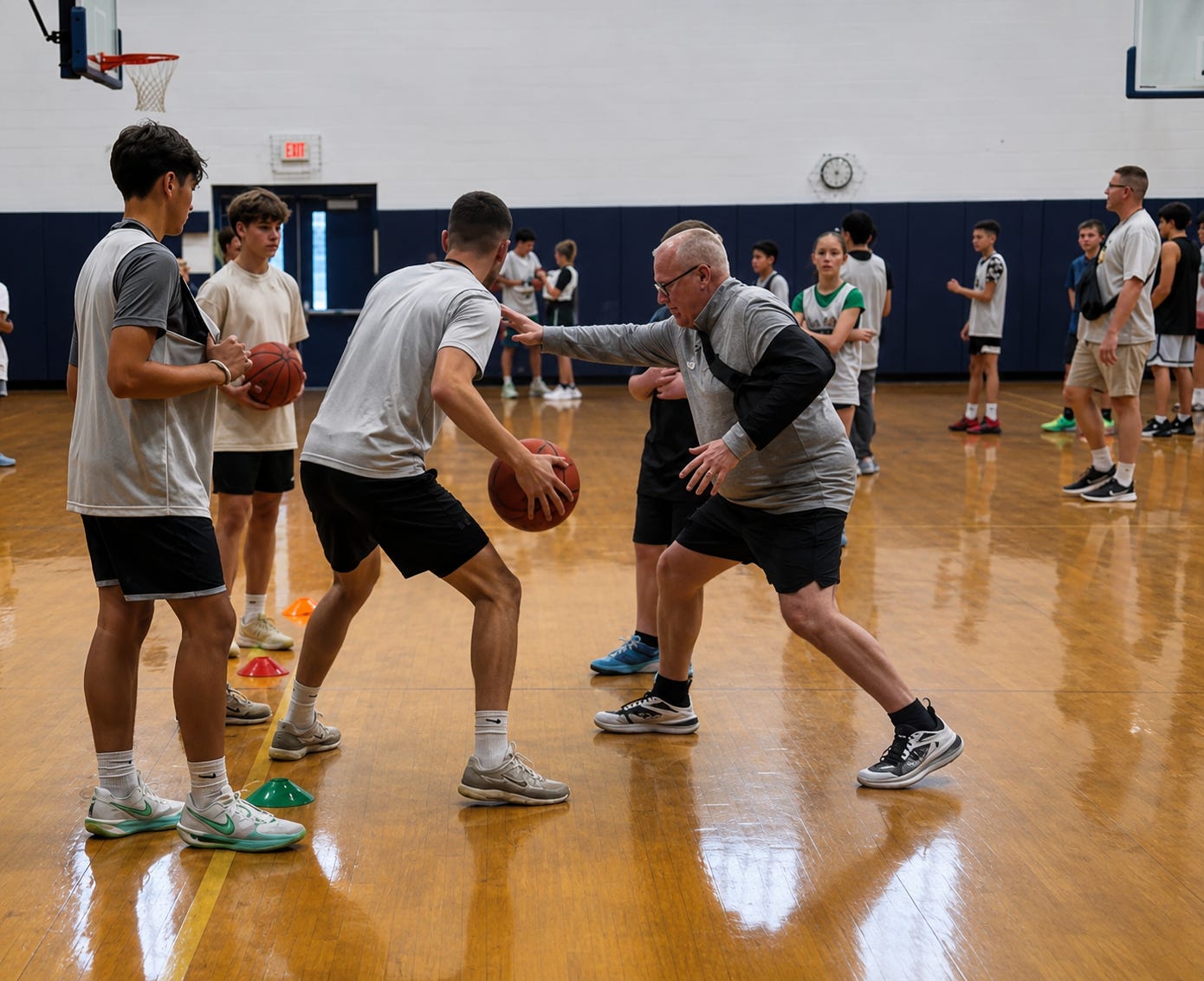
For the past two weeks, I found myself back in a gym I hadn't worked in years.
The basketball camp was run by one of the most respected coaches in our area— a coach whose career has stretched across four decades and whose influence reaches far beyond basketball. The kind of coach whose résumé is impressive, but whose real legacy is scattered across hundreds of former players and young coaches who still carry pieces of his wisdom with them.
I had a few reasons for being there. I had the time. The extra money didn't hurt. But the biggest reason was one that wouldn't fit neatly on a spreadsheet.
I wanted to learn from other coaches.
We've become remarkably good at measuring our lives by numbers. Our phones count our steps before our feet stop moving. Our watches grade our sleep before we've even poured a cup of coffee. Apps track our spending, productivity, heart rate, and habits, while social media keeps score of our followers, likes, and views. Every corner of modern life seems to whisper the same message: if it can be counted, it can be improved.
Numbers can be wonderful tools. They help us train harder, save more, and become more disciplined. But there is also more to the story in my opinion. Somewhere along the way, we've started treating numbers as though they tell the whole story.
The problem is that some of the most valuable parts of life refuse to be measured.
As a school counselor, I spend my days surrounded by numbers. Grades, attendance, assessments, referrals—they all matter, and each one tells part of a student's story. But they're like looking at a landscape through a keyhole. They can tell me who's passing math, but not who's carrying burdens no one else can see. They can tell me who missed ten days of school, but not who found the courage to walk back through the front doors after months of anxiety.
They don't tell me who notices the student sitting alone and joins them at lunch. They don't tell me who keeps showing up after disappointment or who chooses kindness when nobody is paying attention.
Character has always left footprints that data struggles to find.
Sports have the same limitation.
The box score captures points, rebounds, assists, and shooting percentages. But basketball has always been played in the spaces between the stats. It lives in the screen that frees a teammate without asking for credit, the extra pass that never becomes an assist, the dive for a loose ball, the player who celebrates someone else's success as enthusiastically as their own.
Some of the most important plays disappear long before the final box score is printed.
That's why I went back to camp.
Not because I expected a bigger paycheck. I went because I believed that spending two weeks around someone and other top coaches who had devoted a lifetime to coaching would leave me better than when I arrived.
Near the end of camp, the head coach pulled me aside.
For a few minutes we talked about leadership, building a program, and the responsibility that comes with coaching young people. He challenged some of my thinking, encouraged me in ways I didn't expect, and shared a few lessons that took him decades to learn.
The conversation probably lasted less than ten minutes. It may have been the most valuable part of the entire two weeks.
There wasn't a number that could capture it. It won't appear on a résumé or in a paycheck. If you looked only at what could be measured, you might conclude those ten minutes weren't worth very much at all.
I believe the opposite is true.
Years from now, I'll probably find myself repeating one of those lessons to a player without even remembering where I first heard it. I'll make a coaching decision shaped by that conversation. I'll lead a little differently because someone else took the time to invest in me.
That's how the best investments work.
They don't always produce immediate returns. They don't always increase your income or improve your statistics. For a while, it looks as though nothing is happening. Then, almost without noticing, they begin changing the way you see, the way you lead, and the way you live.
What I'll remember is standing in that gym, talking basketball with someone who had spent forty years walking the same hardwood floors, winning games, losing games, facing similar challenges and shaping generations of young people.
See you next Tuesday